How To: Design a Recovery-Ready Safe Treasury
Treasuries shouldn’t wait for an incident to think about recovery. Safe allows teams to design recoverability upfront, as a governance property enforced at execution.
Safe{Wallet}

4 February 2026
Treasuries shouldn’t wait for an incident to think about recovery. Safe allows teams to design recoverability upfront, as a governance property enforced at execution.
When designed intentionally, it ensures authority, accountability, and continuity remain intact as your organization evolves.
This guide shows how to proactively design a Safe setup that remains recoverable under real-world conditions, and how to validate that recovery is possible before it is ever needed.
How does Safe account recovery work?
Safe is a smart account, which means there is no central admin or password reset option – teams retain full control over their assets. Recovery is a programmable outcome of the authority structure defined at setup.
It follows the same on-chain governance logic as every other treasury action: Recovery is permitted only if the configured threshold can still be met by the existing authority. When those conditions are met, ownership and execution authority can be updated onchain, giving teams clear, predictable recovery paths while authority remains intact.
If the control system you designed can still produce a valid transaction, you will be able to regain access. This makes recoverability predictable, testable, and auditable in advance.
What is recoverable and why
Whether a Safe can be recovered is not situational. It is determined entirely by how authority, thresholds, and dependencies are configured upfront.
Recoverable scenarios
One signer is lost and the threshold is still reachable
Remaining owners can execute an ownership change onchain.
Team member leaves the company
Signer rotation succeeds as long as the quorum remains intact.
A hardware wallet is lost, the seed phrase is available
Access to the signer can be restored and governance continues.
In each case, recovery is executed through standard onchain ownership management, as long as the configured threshold remains reachable. Ownership changes do not require special privileges – only valid execution authority. You can also configure fallback recovery mechanisms like trusted backup owners or recovery modules.
Non-recoverable scenarios
Multiple signers are lost and the threshold is no longer reachable
A custodian or MPC signer becomes unavailable when it is required for quorum
A hardware wallet is lost and the seed phrase is not available
If no quorum exists, no action can be taken – including recovery. External dependencies are single points of failure unless they are mitigated by design.
The boundary is clear: recovery exists where execution authority remains possible.
How to design recovery-ready treasury setups
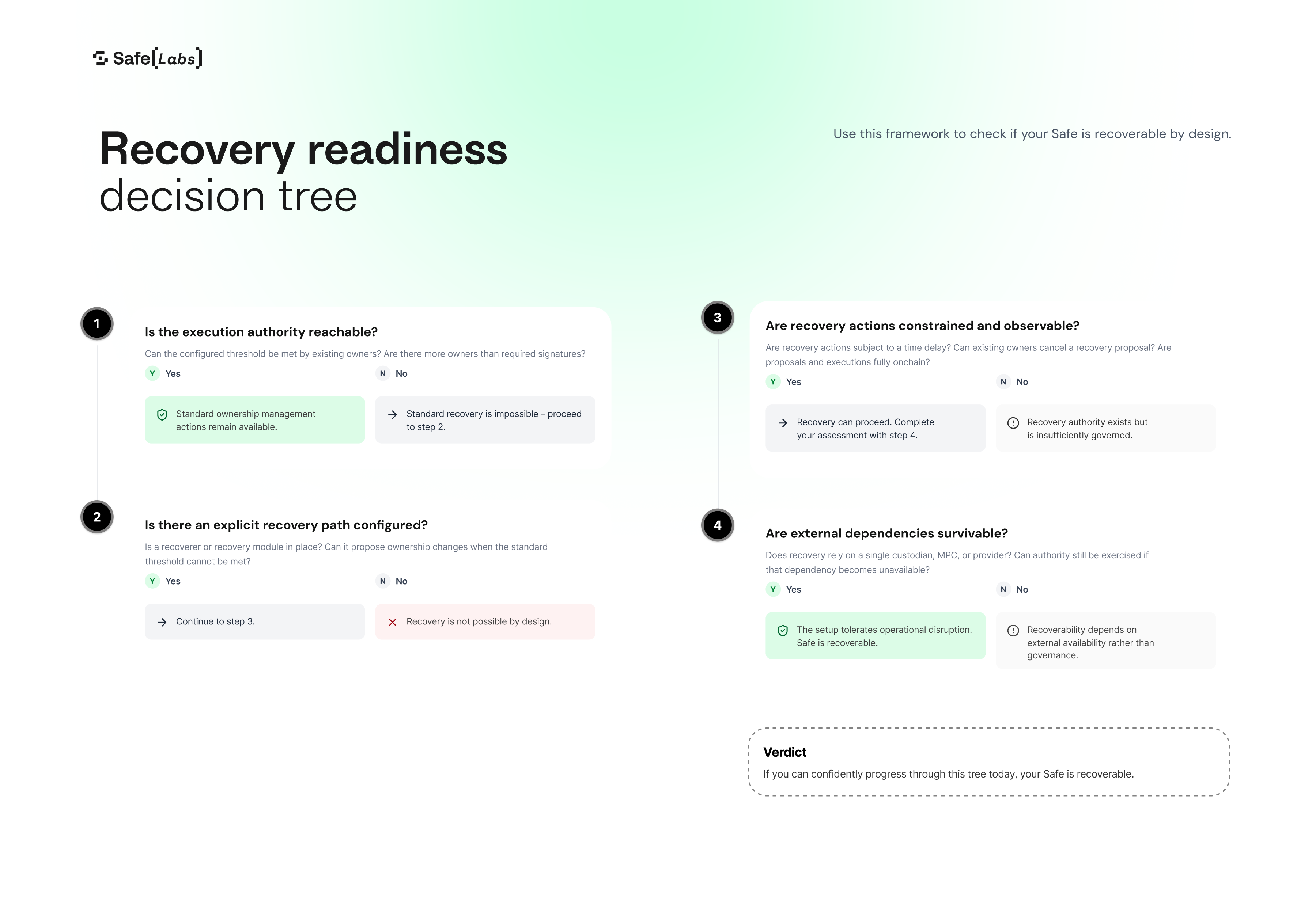
Recovery readiness means being able to answer one question with confidence before anything goes wrong:
Can this Safe still execute a valid transaction if a component fails?
The framework below helps teams validate that answer systematically, and proactively confirm that recovery will be possible under real-world conditions.
Recovery readiness decision tree
Use this framework to check if your Safe is recoverable by design:
Recovery readiness checklist
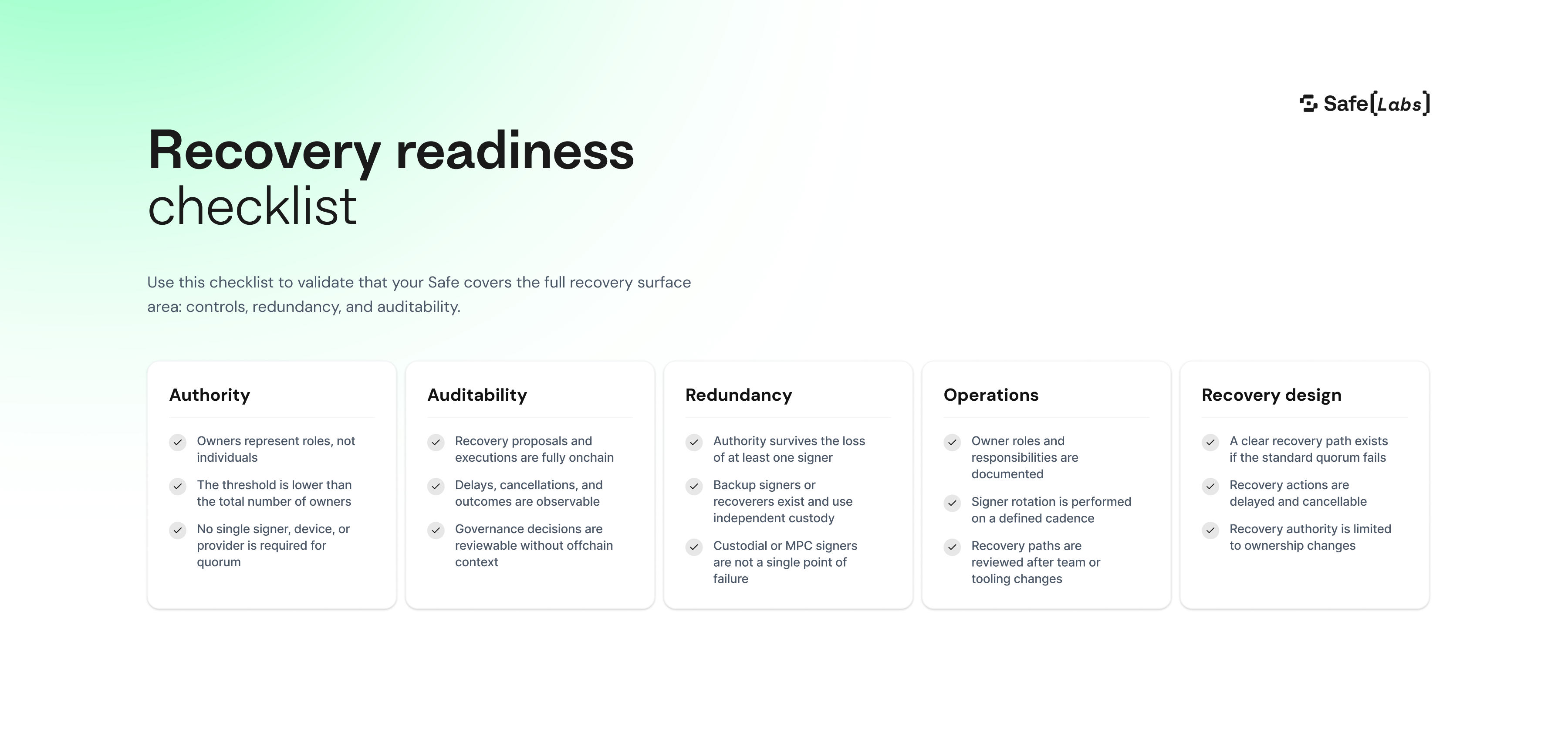
Validating your recovery design
Recovery cannot be intervened in or overridden. Validation must happen before an incident occurs.
Safe provides documentation and tooling references to help teams:
Understand recovery design options
Evaluate whether authority remains exercisable under failure
Follow correct onchain transaction flows for ownership changes
This allows teams to assess recoverability proactively — as part of governance design, not incident response.
What recoverable treasuries have in common
When recovery works, the reason is almost always visible in advance.
Recoverable treasuries are the result of governance decisions that deliberately distribute authority, introduce redundancy, and make exceptional actions observable and reversible.
Common patterns behind failed recovery include:
Thresholds are set equal to the number of owners
Single custodians or MPCs are embedded as critical signers
Undocumented owner roles and unclear responsibility
No preconfigured recovery path for signer loss
No time-delayed safeguards for exceptional actions
Onchain recovery does not fail suddenly. It fails because the system was not designed to tolerate failure.
Good governance makes recovery procedural.
Auditing your treasury setup
Every recovery-relevant action is an onchain transaction. Recovery proposals, delays, cancellations, and executions are observable.
Auditability exists even if recovery is never used. Reviewing your setup today can give you the confidence that recovery will be procedural if it is ever necessary.
To make sure recovery is possible when it matters, make sure it is provable in advance.
Helpful links to review:
If recovery is not provable in advance, it does not exist when it matters.
Safe{Wallet}
4 February 2026

Copy link